
"Scallops, fish, egg, and peanuts are all excellent companions to congee precisely because they nourish what Chinese medicine calls the source qi or constitutional level of health..."
Rice congee is a classic Chinese medicine super-meal for fertility and for promoting the natural production of mother's milk. It is also one of the most broadly health-supportive foods in any tradition — and one of the easiest to make.
Congee has been a cornerstone of women's postpartum care across Asian cultures for thousands of years, and the reasons are quite precise.
With this special cooking method, water is absorbed deeply into the structure of the rice grains so fluids are released gradually during digestion — a kind of time-released hydration that moves fluid into the body in a form we can actually use. We're not talking here about glasses of water that pass right through. We're talking about fluid that integrates, that becomes part of the body's own reserves.
This is easy to observe as you cook the congee. Often, when you believe it to be ready, you turn your attention elsewhere for a moment and the congee thickens again. If so, simply open it up with a bit more boiled water. Cooking congee is an essential experience in beginning to understand how fluids work in the body: if the rice in the pot continues to absorb so much fluid, it must be doing something similar inside our digestion. One reason congee is so beneficial is that we are eating the grain after it has absorbed as much fluid as it will. That's when it's done and ready to eat.
In Chinese medicine, fertility fluids, breast milk, and the deep moistening within the body — in both women and men — are expressions from the same reservoir. When that reservoir is well supplied, the body produces abundantly. When it's depleted, as is so often the case in modern life and especially after childbirth, production suffers.
Congee replenishes at this level. Energetically, wet-cooked rice strongly nourishes Stomach Yin and fluids — the foundational source from which these deeper reserves are built and sustained.
This is also why congee is the traditional breakfast for weak digestion, convalescence and recovery, and the chronic dehydration that underlies so many conditions people struggle with today unnecessarily.
The Accompaniments Are Not Optional
Serving congee with the right accompaniments is essential. The classic combination — slivered ginger, sliced scallion, a splash of good soy sauce, toasted sesame oil — is far more than garnish. Each element has a precise function.
Ginger harmonizes digestion and resolves bloating. The scallion and soy sauce together bear a remarkable resemblance to a very old herbal remedy from Chinese medicine: Cong Chi Tang, a decoction described by the early Daoist sage Ge Hong (283–343 CE). In it, scallion whites and fermented soybeans are combined to treat the onset of a common cold — the fermented soybeans nourish fluids, while the mild spiciness of the scallion moves those fluids upward to the Lungs and outward to the skin, gently opening the exterior. Fresh ginger supports this same strategy. Toasted sesame, meanwhile, resonates with Kidney energetics — when toasted, sesame seeds are more uplifting, working more with what Chinese medicine calls Kidney Yang, roughly equivalent to adrenal function: a gently energizing quality that is nicely appropriate for morning.
Some kind of protein and fat is almost always served with congee as well. A boiled or poached egg is the easiest to digest — protein and fat together, wet-cooked to match the nature of the dish. This matters more than it may seem. A boiled egg with congee is very different from a fried egg with dry toast, even though both are egg and grain. Wet cooking is far gentler on the digestive system. Wet-cooked eggs do not burden the Liver and Gallbladder the way fried eggs can, and it is that burden — with the resulting heat at the blood level — that may contribute to inflammation over time. Simply put: boiled or poached eggs with congee nourish while supporting digestion and protecting against inflammation simultaneously.
Another favorite in our household is congee made with dried scallops, found in most Chinatown markets at varying price levels. Drying concentrates their flavor enormously, creating something unique and wonderful. Begin by rehydrating three or four dried scallops per person in ten cups of cool water, then bring that water toward a boil and use it to cook the congee. Scallops, fish, egg, and peanuts are all excellent companions to congee precisely because they nourish what Chinese medicine calls the source qi or constitutional level of health. The wet-cooked rice and source-level protein make a powerful combination — nourishing both the digestive qi and the constitutional reserves in a single bowl.
A Few Guidelines, and Common Mistakes to Avoid
Home cooks coming to congee for the first time tend to make certain consistent errors:
Do not use leftover cooked rice. It is the slow, gradual absorption of water into the raw grain that gives congee its character. Leftover rice is useful, but for fried rice — an entirely different dish with an entirely different energetic effect.
Include oil and salt from the beginning. A tablespoon or two of good quality oil — avocado, grapeseed, organic peanut, safflower — and a generous pinch of salt are not optional. The salt provides a mineral quality that resonates gently with the Kidneys, much as extreme saltiness stresses them. The oil does more than help the dish cook; good oil is needed in the body for building every cell membrane and all our hormones, from bones to brain.
Add more water than you think you need. Congee will thicken as you look away. Keep a pot of boiling water nearby and add freely. The finished texture should be milky water surrounding very soft, discernible grains — a loose, flowing bowl, not a thick paste.
Never eat congee plain. It is always completed with condiments, and almost always with a protein. If unwell, simple condiments alone are fine until appetite returns. But clarity of composition matters: avoid adding too many things to one bowl. As with any dish, restraint produces a better result than accumulation.
Rice Congee with Scallops & Wakame

Ingredients:
- Long or medium-grain white rice (Asian-style preferred) | 1 cup
- Dried scallops | 2 small handfuls
- Water, plus more as needed | 10 cups
- Grapeseed oil (or avocado oil, organic peanut or safflower) | 2 tbsp
- Salt | 2 generous pinches
- Wakame | small handful, soaked in hot water until soft
- Fresh ginger | 1 knob, peeled and slivered
- Fresh scallions | 2–3, sliced (or use an equivalent bunch of chives)
- Tamari | a generous splash, to taste
- Toasted sesame oil | a generous drizzle, to finish
directions:
Step 1: Rehydrate the Scallops
Place the dried scallops in a pot with the water and bring slowly toward a boil. They will soften and eventually begin to break apart — this is exactly what you want.
Step 2: Prepare the Rice
Wash the rice well under cool water until it runs mostly clear. Transfer to a large heavy pot. Add the oil and stir so each grain is lightly coated. Add the salt. Do not skip the oil or salt — they are not afterthoughts.
Step 3: Begin the Absorption
Add just enough water to cover the grains at first. Stir constantly as the grains absorb the water. When most water has absorbed, add another ladleful. Repeat through 3 or 4 gradual additions over about 10 minutes, stirring nearly continuously. You will see the water turn milky as the rice releases its starch — this is the moment the congee begins.
Step 4: The Long Simmer
Once the grains have given up their starch to the water, add the remaining water. Reduce heat to a low simmer, cover, and cook for 30–45 minutes, stirring occasionally. Do not allow the grains to settle and stick. Add boiling water if needed — congee thickens as you look away. The finished texture should be milky water surrounding very soft, discernible grains: loose and flowing, not thick.
Step 5: Soak the Seaweed
While the congee simmers, soak the wakame in hot water for a few minutes until softened and pliable. Drain and set aside to be added at serving.
Step 6: Serve
Ladle the congee into bowls. Arrange the softened seaweed and soft scallops on top. Add slivered ginger and sliced scallion or chive. Finish with a generous drizzle of tamari and toasted sesame oil. The bowl should feel complete but uncluttered — clarity matters more than abundance. Congee is never served plain.
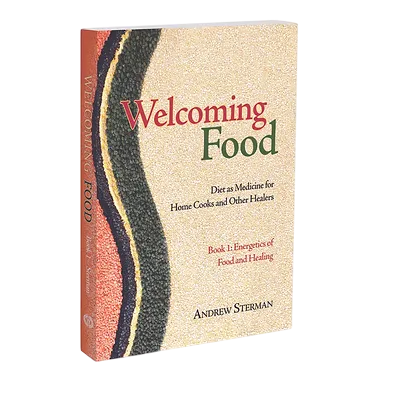
Welcoming Food Books
The two-volumes of Welcoming Food by Andrew Sterman explains Chinese medicine food energetics in clear, practical terms, with simple recipes and step-by-step guidance for using food to maintain or return to optimal health.

Enter your details below, and I’ll send you my latest recipes and writings, directly to your inbox.
Thank you!
You have successfully joined our subscriber list.
Share this:
- Share on Facebook (Opens in new window) Facebook
- Print (Opens in new window) Print
- Email a link to a friend (Opens in new window) Email
- Share on WhatsApp (Opens in new window) WhatsApp
- More
- Share on LinkedIn (Opens in new window) LinkedIn
- Share on Reddit (Opens in new window) Reddit
- Share on Tumblr (Opens in new window) Tumblr
- Share on Pinterest (Opens in new window) Pinterest
- Share on Telegram (Opens in new window) Telegram
- Share on Threads (Opens in new window) Threads
- Share on Mastodon (Opens in new window) Mastodon
- Share on Nextdoor (Opens in new window) Nextdoor
- Share on X (Opens in new window) X
- Share on Bluesky (Opens in new window) Bluesky