
"I remember a representative from Monsanto claiming on television that "roundup" brand glyphosate weed killer was safe for humans to consume, even to drink straight, then bolting from the studio when..."
I work in diet and healing from a classical perspective, focused on the energetics of foods. Politics never enters the healing space—everyone is welcome. A safe and undefended space is necessary for the deep work that we do.
Yet when it comes to diet, at some point we all need to become aware of the industrial forces that shape food policy from farming through the onslaught of advertising and consumption pressure. We are in it, we are subject to corporate influence on government which effects the safety of food in profound ways. We have a right to learn, think, and discuss this. We have a right to share ideas of how to navigate the system. As the great author/farmer Wendell Berry wrote, “We have a food system that doesn’t care about health, and a healthcare system that doesn’t care about food.” We are long past the point where we can safely shrug this off.
The Rise of Industrial Agriculture and Chemical Farming
The history of the modern food supply includes several nearly unstoppable currents. One is the advance of the technological paradigm, the ideas that have moved medicine and farming both to over-reliance on chemical interventions. This need not be an “all or nothing” argument; we can agree that some is good, but too much is too much.
The other very strong current, starting in America, has been the agriculture subsidy legislation from the Nixon era about 1970. With the intense social conflict of the Vietnam war years and Nixon’s own contentious presidency, a decision was made that food uncertainty and high prices could undermine things further for the administration. The farm bill was intended to stabilize prices and calm dissent by direct government subsidies to farmers growing staple foods: wheat, corn, soy, sugar, milk, and beef.
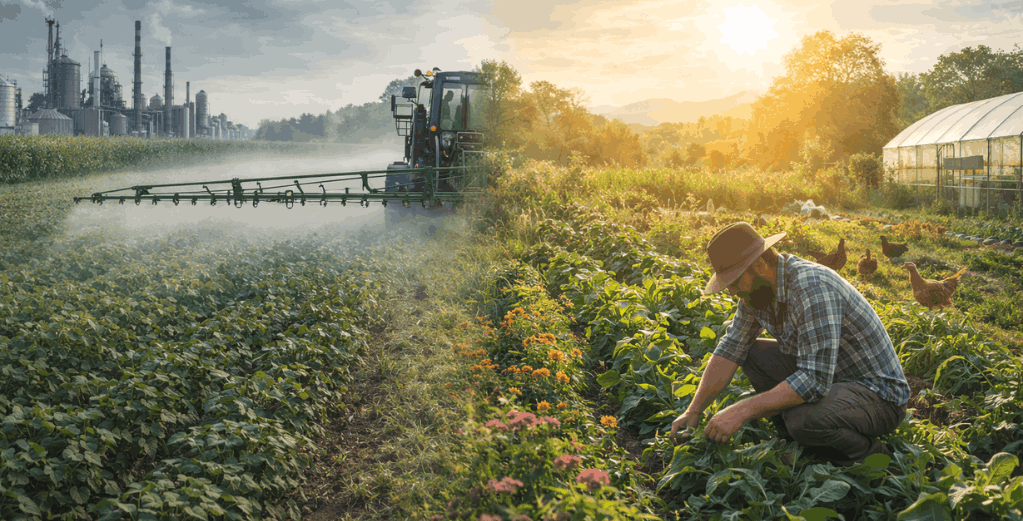
The unintended result was that enormous amounts of incredible farm land became converted to growing those foods in the cheapest possible way. Farm debt issues added to the ever-increasing pressure for vast mono-crop farming reliant on inorganic fertilizers, pesticides, and eventually genetically altered seeds designed to tolerate massive herbicide use. The amounts of chemicals sprayed on crops is far beyond “a little help”. Once harvested, these frankenfoods are not intended to be cooked and eaten, they are grown for the fast-food market and a food industry that processes them into the thousands of products that fill supermarket shelves, filled with stabilizers, colorings, artificial flavorings, massive sweetness, preservatives, and more. It’s not outrageous that these things exist, but it is outrageous that they increasingly push real food off shelf space, foods that we need for health and genuine food satisfaction. Our obesity crisis is in large part due to the way these foods are not satisfying in normal amounts. We have been told all this is necessary to feed our large populations, that it is safe, and that no other way is possible. All three statements are untrue. There are growing movements for quality farming that offer practical and realistic advice.
Glyphosate, Roundup, and the Growing Debate Over Food Safety
And this brings us to the current debate over glyphosate. I remember a representative from Monsanto claiming on television that “roundup” brand glyphosate weed killer was safe for humans to consume, even to drink straight, then bolting from the studio when the host offered him a glass of his company’s product. Since then, glyphosate has been banned in a handful of our ally nations, found in court cases to be responsible for cancers, and more. It seems that glyphosate is not only carcinogenic but seems to open the lattice-like membranes of the small intestine, binds with aluminum, then ferries that toxic metal into the blood system. And we are splitting on predictable political lines about whether to protect public health or double-down on false safety claims of a 2.8 billion-dollar chemical (in the United States alone last year).
Organic and Regenerative Farming as Practical Alternatives
From a health perspective there is little debate. The issue globally is more nuanced, and it’s common sense that modern farming is addicted to glyphosate and the other chemicals used on such vast scale, and conversion can’t happen overnight. And yet, Mexico has banned glyphosate and is thriving agriculturally, as one example. We could aim for the European standards, which are stricter than US rules in significant ways and with noticeable benefit. And of course, we as individuals can vote with our wallets by supporting organic and regenerative farmers more and more.
The effects of such a shift is more than improved health and protection from serious illness. When we spend a small amount of time and just a bit more budget, we are eating food that is incomparably better tasting.
For those curious about how simple ingredients can come together in nourishing, everyday meals, I’ve shared a number of recipes on the website. Two good places to begin are the White Fish & Mushroom Recovery Soup and Small Yellow Beans, Kale, Brown Rice With Tahini Sauce, both designed to show how simple cooking can be both delicious and healthy.
And one last note. In these times which challenge personal health and the health of the planet itself, it may be that this current American administration has one good thing going for it, which is a structured attempt to steer our food supply in a better direction. If only it is able to agree with itself and get as much done as possible. For the sake of everyone, we need short term and profound long term changes in our food supply.
Welcoming Food Books
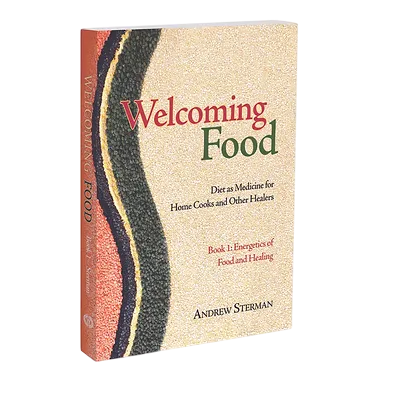
If you want practical guidance on how to begin cooking and eating this way at home, my books Welcoming Food: Diet as Medicine for the Home Cook and Other Healers offer a simple entry point—explaining the energetics of food in everyday language and providing recipes designed for daily life.

Enter your details below, and I’ll send you my latest recipes and writings, directly to your inbox.
Thank you!
You have successfully joined our subscriber list.
Share this:
- Share on Facebook (Opens in new window) Facebook
- Print (Opens in new window) Print
- Email a link to a friend (Opens in new window) Email
- Share on WhatsApp (Opens in new window) WhatsApp
- More
- Share on LinkedIn (Opens in new window) LinkedIn
- Share on Reddit (Opens in new window) Reddit
- Share on Tumblr (Opens in new window) Tumblr
- Share on Pinterest (Opens in new window) Pinterest
- Share on Telegram (Opens in new window) Telegram
- Share on Threads (Opens in new window) Threads
- Share on Mastodon (Opens in new window) Mastodon
- Share on Nextdoor (Opens in new window) Nextdoor
- Share on X (Opens in new window) X
- Share on Bluesky (Opens in new window) Bluesky