

The more technological food trends I learn about, the more I am compelled to see things simply. There is an obvious belief within tech health hacks: we are not capable of eating well, so we may as well give in, eat whatever is for sale and take a pill, a shot, or add some superfood to our habitual diet.
This brings to mind the ancient Popeye cartoons, hand-animated, old-school, where an impossible situation arises and Popeye is nearly defeated, until he finds one improbable can of spinach to squeeze open with his last strength. The Popeye theme music tells us things may be looking up, and indeed, once Popeye eats the spinach he does the impossible and saves his girlfriend Olive Oyl and all the rest of the good guys. I suppose the idea was to encourage kids to eat their veggies, but the message that one thing can fix our weaknesses is fundamentally a terrible idea, even if that “thing” is a vegetable.
Today, the prevalent underlying message is, “Keep living as you are, it’s a normal civil right to do so, and then come to us to take our product to fix everything.” But in truth, there are no superfoods, and there are no super tech hacks that will fix us when we continue the diet that causes our problems.
This leads me again to the way every new trend compels me to think more and more simply. Maybe the assumed idea that we can’t change how we live is wrong. When I meet a new health client, the first thing I look for is where they are willing to change. How free are they? Where are they locked into the habits that are causing their distress?
Maybe spirulina will fix my inflammation, or turmeric/pepper pills. Or maybe I need to eat like a caveman to solve the modern diseases, ignoring the vast modern system needed to provide that amount of fresh steak and the fact that cave folks had to fight other animals for meat scraps, often on their way to spoiling. Maybe AI can figure out how to make unnaturally folded proteins that can literally solve every disease. Maybe enzyme supplements can fill in where my own system is exhausted, or new-tech peptide pills can target exactly what I need. Maybe, but the idea beneath all of this is that we are incapable of change. This is medical cynicism fueled by profit mining of an affluent but passive population. I don’t carry that thought; none of us need to.
Eloise wrote requesting a session. She was, in her words, overweight, and after flirting for years with pre-diabetes, she reported that her lab tests showed consistently that she had crossed to a full diabetes diagnosis. Her doctor said not to worry, that it can be managed, but it is now her condition for life, there is no going back. This offended something very deep in Eloise, who then started looking for a different way of seeing what is possible. She reported to me that something snapped inside. She didn’t know what she was looking for, but she knew there was another way.
As mentioned above, the first thing I look for is a client’s willingness to change. We chatted for a couple minutes about what seemed like nothing, until Eloise said, “You know, I always knew this was coming. With the way I eat.… Everybody knows I’m ‘heavy’, but nobody says anything, and a lot of my family and work circle are really big, too. It’s almost a relief that it’s finally here. Now, at least I have a diagnosis. But I’m ready now, I’m not going down this road any longer, no matter what it takes, I am just not this person deep down.”
There it was, the willingness to change, in beautifully clear and profound form. Over the next few weeks we plumbed a whole set of negative beliefs that were tied up with her food habits. Each session combined dredging deep food programming with new recipes and cooking methods. She found a lot of difficult emotional history with food and applied herself with true strength. In one sense she is unusual, moving from a standard American diet to home cooking real food, but at the same time there is no question that all of us can do this. In one session she told me, “You know, I don’t miss my old food at all, this way of eating is so delicious. My old food didn’t even satisfy me, even as I overate it, but I find this food deeply satisfying. It tastes way better, and it’s not hard to make. Eating at home is cheaper, too. What was I thinking before?”
And the results are noticeable in steady significant weight loss with renewed energy, and verifiable by repeated lab tests now showing a reversal of the diabetes diagnosis. Eloise’s doctor is impressed but doesn’t think her success could work “at scale.” In other words, at the scale of the catastrophe of our current public health.
But this is precisely an idea that I don’t believe. The food industry has no incentive to be honest about how to support our health. Profit is in processed foods and prepared meals. Prepared meals use frighteningly cheap oils and cheap ingredients, designed for irresistible repeat purchasing. Restaurants over-complicate their dishes in conveyor belt food theaters. Like Popeye, we are lulled into thinking we can wait until our strength is exhausted and then reach for a supercharger (pick the trend of your choice).
Our choice is not limited to which super method we put our faith in, whether “health foods”, tech foodstuffs, supplements, or bespoke GMO protein miracles. We can choose to cook one or two of our own meals each day, building meals from true foods, actually farmed and cooked simply. The secret to healing is changes of lifestyle. Treatments can be complicated, but essential lifestyle change has simplicity as its guiding principle, and everyone can do it. Treasure good rest, hydrate well, eat real food, breathe freely and exercise gently.
A few sample meals are below. The more high tech health hacks I hear about, the more I am compelled to think simply. Certainly, there are times for expert intervention, but even then, all medical treatments will be more successful if supported by real food. Sustained simplicity has never let us down.
Some Meal Ideas
Another secret is that food energetics can be applied in ways that are precise, brilliant, and conceptually advanced to meet specific life conditions and needs. There is so much we can do and I’ll write about that at other times. But in today’s world, working “at scale,” simple cooking is the shift we need most. Here are a few easy real meal ideas.
- Steamed rice with lightly sautéed zucchini and lemon-butter flounder.
- Ground beef sautéed with scallions, steamed broccoli with olive oil and sea salt, whole-grain bread from a real bakery.
- Chickpeas lightly smashed with parsley, olive oil, and sea salt along with steamed cabbage with butter over organic pasta or wheat-free noodles.
- Homemade chicken soup with carrots, daikon, celery, and chopped kale, seasoned with turmeric, oregano, and freshly cracked black pepper.
- Spinach omelette with roasted sweet potatoes and buttered string beans.
Welcoming Food Books
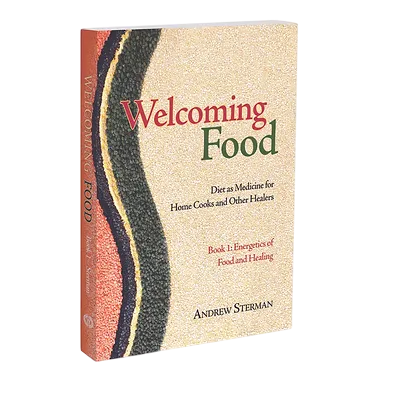
The two-volumes of Welcoming Food by Andrew Sterman explains Chinese medicine food energetics in clear, practical terms, with simple recipes and step-by-step guidance for using food to maintain or return to optimal health.

Share this:
- Share on Facebook (Opens in new window) Facebook
- Print (Opens in new window) Print
- Email a link to a friend (Opens in new window) Email
- Share on WhatsApp (Opens in new window) WhatsApp
- More
- Share on LinkedIn (Opens in new window) LinkedIn
- Share on Reddit (Opens in new window) Reddit
- Share on Tumblr (Opens in new window) Tumblr
- Share on Pinterest (Opens in new window) Pinterest
- Share on Telegram (Opens in new window) Telegram
- Share on Threads (Opens in new window) Threads
- Share on Mastodon (Opens in new window) Mastodon
- Share on Nextdoor (Opens in new window) Nextdoor
- Share on X (Opens in new window) X
- Share on Bluesky (Opens in new window) Bluesky